
A guide for architects and interior designers
Private label vs. custom manufacturing in China
Compare branding an existing product with developing a custom design, including sampling, tooling, ownership, testing, and repeat orders.
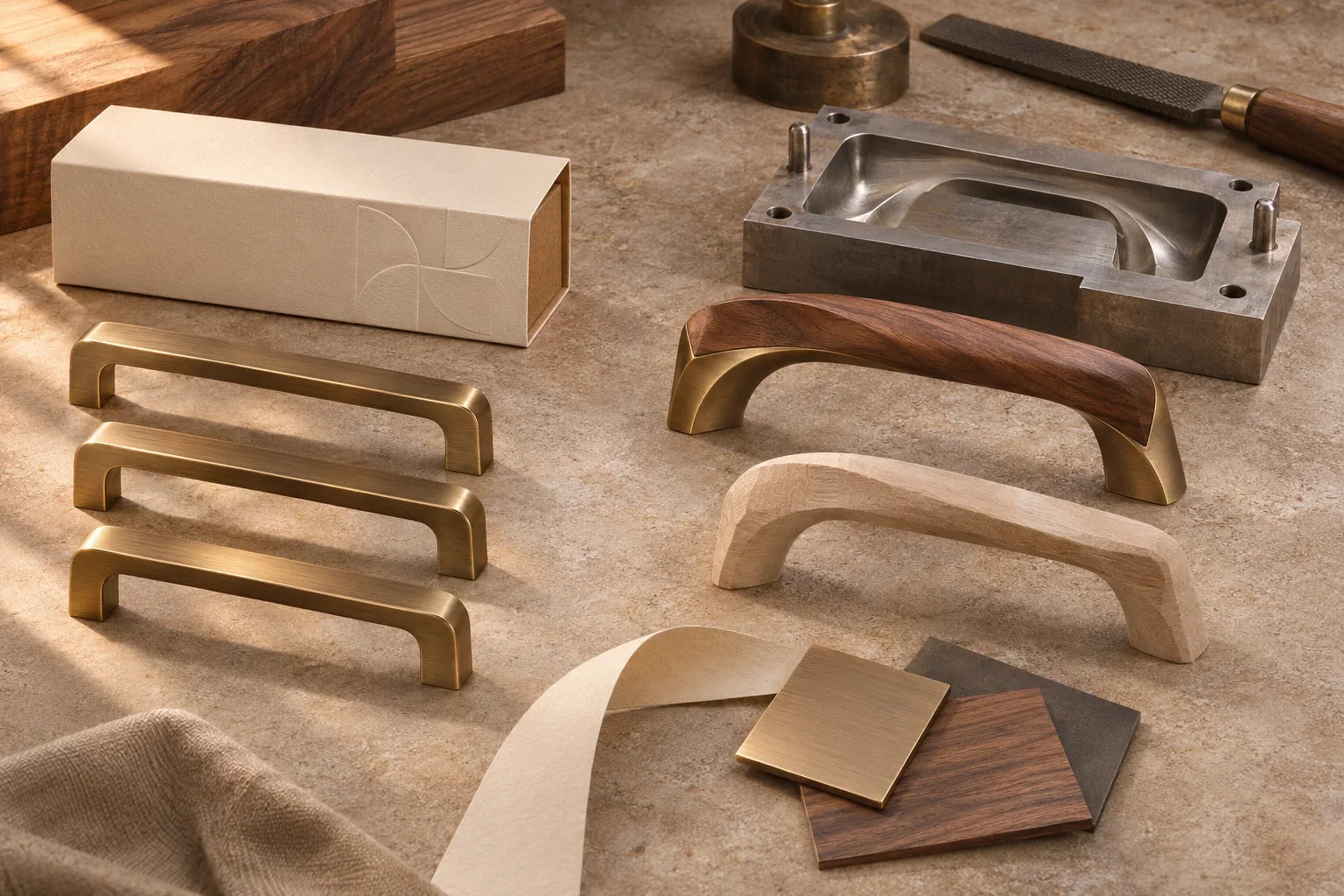
Putting your name on an existing cabinet handle and developing a new handle profile are different purchasing projects. One may mainly involve artwork and packaging. The other can require drawings, tooling, prototypes, testing, and several rounds of approval.
Describe the changes you need before asking a supplier for “custom” or “private label” production. Suppliers use these labels differently. A precise scope makes quotations easier to compare.
Separate branding, adaptation, and new development
Use a written change list. Identify which parts of the supplier’s existing product remain the same and which parts will change.
| Approach | Example | Main questions |
|---|---|---|
| Private label | Existing fitting with approved branding and packaging | Can you lawfully use the product and brand it? What artwork and order quantities apply? |
| Adaptation | Existing chair in a different fabric or finish | Does the change affect construction, testing, lead time, or replacement parts? |
| Custom development | A new handle profile made from your drawings | Who develops and owns the drawings, prototypes, tooling, and resulting rights? |
Terms such as OEM and ODM do not settle these details. Ask the supplier to explain what they design, what they manufacture, and what they are authorised to sell. Record the answer in the purchasing documents.
Start with the requirement that creates value
For an interior project, a new dimension may be essential because the product must fit a specific opening. A unique finish might be needed to match adjoining metalwork. A custom carton may be useful only for retail presentation.
List the requirements that cannot change. Then consider whether an existing product can satisfy them. Ask for a separate price and lead-time effect for each proposed modification. That lets you remove an expensive change that adds little value.
Avoid selecting a catalogue product solely from a photograph. Request drawings, material details, dimensions, applicable test evidence, and a physical sample suitable for your intended use.
Make the development quotation complete
Request separate amounts for development, samples, tooling, testing, artwork, packaging, and production. Identify which fees are refundable or credited against a later order, if any. Put that agreement in writing.
The quotation should also state:
- The design inputs you must supply and their required format.
- The number of prototype or sample revisions included.
- Which changes trigger an additional charge.
- Minimum quantities by model, finish, and packaging version.
- The conditions that start each production or development stage.
- How rejected samples and failed tests will be handled.
- Storage, maintenance, and replacement arrangements for tooling.
Compare the full launch cost and the cost of repeat orders. An affordable first batch may depend on tooling that cannot be transferred or on a component the supplier plans to discontinue.
Resolve ownership before sharing detailed files
Ask who owns existing designs and who will own any work created for your project. Paying for a mould or drawing does not, by itself, answer every ownership, access, or usage question. Agree the rights and practical arrangements in a suitable contract.
WIPO explains that industrial design rights concern a product’s appearance and are territorial. Protection in one country does not automatically protect the design everywhere. Public disclosure can also affect the ability to obtain protection, depending on the applicable law. WIPO’s industrial-design guidance
Before disclosing valuable files, get advice on the countries and rights relevant to your project. IP Australia’s China guidance recommends due diligence and suitable agreements when working with manufacturing partners. The exact contractual approach needs review for your transaction. IP Australia’s guidance on collaborating in China
For tooling, record an identifier, physical location, permitted users, maintenance responsibilities, expected condition, and release or transfer procedure. Ask what happens if you stop ordering or change manufacturers.
Protect confidential information in practice
Share only the information needed at each stage. Mark confidential files, control who receives them, and keep a record of issued revisions. Clarify whether subcontractors may receive drawings or components and what obligations apply to them.
Confidentiality agreements are one measure among several. WIPO describes trade-secret protection as depending in part on reasonable steps to keep valuable information secret. Those steps can include contractual restrictions and access controls. WIPO’s trade-secret guidance
Keep design ownership and third-party rights in view. A supplier’s ability to reproduce a well-known product is insufficient evidence that you can lawfully import or sell it. Resolve permission and clearance questions before committing to production.
Approve the product in stages
Agree the approval sequence with the supplier. A useful sequence might include drawings, a material or finish sample, a prototype, a production sample, and inspection of the completed batch. Match the stages to the product’s complexity and consequences of failure.
Give every approved drawing and sample a reference. Record dimensions, tolerances, colour or finish references, materials, components, packaging, and required performance. Define who can authorise a change.
For a lighting product, replacing a component or modifying construction can affect the relevance of existing test evidence. Ask a qualified testing or compliance provider which evidence applies to the exact final configuration and destination. Complete that check before shipment.
Approval of appearance alone should not release an order whose mechanical or electrical requirements remain unresolved.
Plan the second order while negotiating the first
Ask how the supplier will reproduce the approved finish, identify the correct files, maintain tooling, and source replacement components. Agree whether a new sample or test review is needed after a material, component, or manufacturing change.
Keep your approved specification and production records independently of the supplier’s account or messaging history. Before placing a repeat order, confirm the revision, price, available materials, and production conditions. A clear record makes it possible to buy the same product again or explain precisely why the next batch must change.
Our guide to buying from China covers the wider purchase sequence and destination checks to complete alongside product development.